
Stop Fighting Your Brain: A Productivity System for the Chronically Disorganized
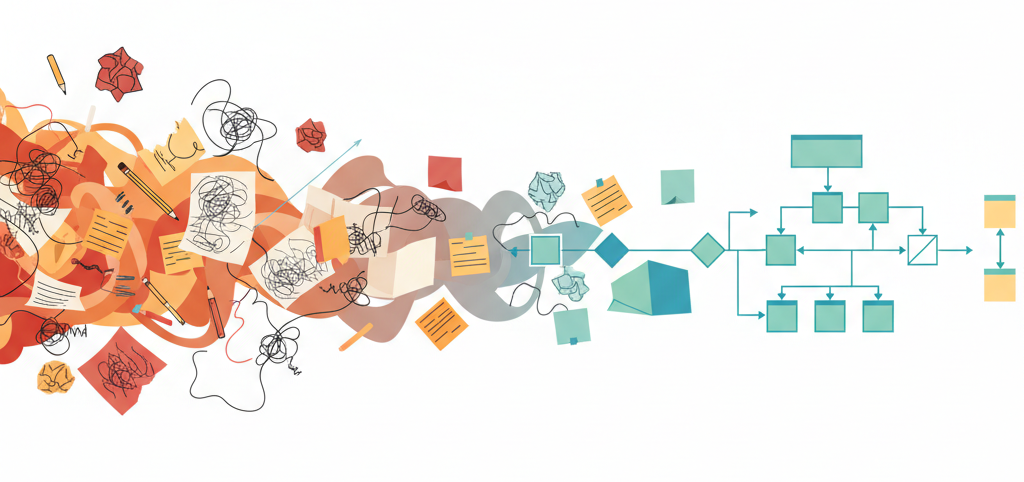
Most of us are better at designing productivity systems than sticking with them.
I spent years proving this. I tried every system. They all failed — not because they were bad, but because they all share the same design flaw: they depend on you. Your discipline. Your consistency. Your willingness to do the organizing.
What if the system didn't need you at all?
That's what I built. One that organizes itself, surfaces what matters, and actually helps me create — instead of just rotting on my hard drive. Here's how.
Every System I Tried (And the Flaw They Share)
There's a framework the productivity world uses called CODE — Capture, Organize, Distill, Express.
- Capture: Get the idea into your system
- Organize: File it, tag it, link it — give it a home
- Distill: Refine raw ideas into something useful
- Express: Ship something — the only step that actually matters
Every method is a different answer to these four steps. I tried most of them.
Zettelkasten — The slip-box method Niklas Luhmann used to write 70 books. Every note gets a unique ID, linked to others. I hated deciding where every note goes. I wanted my system to do that.
Evergreen Notes — Notes about concepts, not events. Instead of "Meeting notes 2024-03-15," you write "Good feedback requires psychological safety." Great idea — until I forgot how I titled notes and couldn't find them.
PARA — Four buckets: Projects, Areas, Resources, Archives. Sounds simple until you're staring at a note deciding which bucket it belongs in.
Maps of Content — Index pages linking related notes, like Wikipedia pointing to deeper pages. I tried generating these with code. Ended up staring at giant lists with no idea what to do next.
Getting Things Done — David Allen's classic. Inboxes, next actions, contexts. It lasted until maintaining the system took longer than doing the things on the list.
Bullet Journaling — Loved it, actually. But I can't beat the searchability of digital.
After the hype of trying a new system faded, I ended up with a daily journal in Obsidian and a TODO list I copied forward every day. Like a jackass.
Every one of these systems is designed to fail. Not because the ideas are bad — they correctly identify the steps of knowledge work. But they all assume you'll show up every day to do the filing, the linking, the reviewing. That's not a discipline problem. That's a design flaw.
The Part Where I Stopped Being the Bottleneck
I stitched together my own Frankenstein — daily journal, linked notes, maps, TODO list bolted on the side. It worked when I worked, but the moment I skipped a nightly ritual, things vanished.
Then it clicked. Every system I'd ever tried had the same three components:
1. A Brain (yours) to process things
2. Context (notes) to work with
3. Tools or processes to act on them
The context was fine — my notes were good raw material. The tools worked. But the brain was me. And my brain doesn't do filing, linking, and reviewing. It does forgetting, skipping, and meaning to get to it later.
AI doesn't need discipline. It doesn't forget. It doesn't get bored. What if I swapped out the one failing component and kept everything else?
Your mess isn't the problem. It's the raw material.
What I Built (Same Steps, Better Brain)
Capture was never my problem. I mapped my iPhone's action button to record and transcribe voice memos that save straight into my notes — one press, talk, done. The steps that killed every previous system were Organize, Distill, and Express. Those are the ones I handed to AI.
Organize
This was the step I hated. So I made AI do it.
First, I added vector search — semantic search by meaning, not keywords. "What have I written about fear?" surfaces entries I'd forgotten existed.
Then I had AI cluster my journals by theme — reading entries, identifying patterns, building maps automatically.
Here's what it built from my actual notes:
Personal Growth & Learning ──────────────── 95 notes
├── Learning & Skill Development (19)
├── Values & Identity (17)
├── Wisdom & Discernment (15)
├── Challenge & Growth (10)
├── Self-Compassion (7)
└── Key Insights (16)

Power & Confidence ──────────────────────── 101 notes
├── Personal Power (16)
├── Building Confidence (11)
├── Fear & Courage (13)
│   ├── Fear is a mile wide and an inch deep
│   ├── Courage is acting in spite of fear, not eliminating it
│   └── ... 11 more
├── Self-Worth & Identity (13)
├── Agency & Choice (11)
└── Key Insights (11)

Relationship Wisdom ─────────────────────── 83 notes
├── Romantic Relationships (27)
├── Communication Skills (16)
├── General Wisdom (14)
└── Family & Professional (12)
Nearly 280 notes. I didn't file a single one.
But here's what surprised me: I was staring at my own content pillars. Themes I'd been circling for years — fear, identity, relationships, self-worth — laid out in a structure I'd never been able to articulate. I knew these were the things I cared about but I could never pin them down or explain how they connected. And now here they were, automatically organized from two years of messy journal entries I thought nobody would ever read. Including me.
Distill
Before this, I couldn't distill anything — I couldn't even find anything. I'd sit down wanting to "review my notes" and immediately get lost in the pile.
Now I type a command and the system goes hunting. It scans my notes for ideas that are underdeveloped — minimal links, haven't been touched in months, sitting there waiting. It picks one and presents the core idea back to me.
Last time I ran it, it pulled up a note I wrote six months ago about how childhood survival strategies still run in the background as adults — "child-based algorithms operating in adult landscapes." I'd completely forgotten about it. The system found it, summarized the core tension, and asked: want to work with this one, or should I find something else?
I said yes. It offered to pressure-test the idea through Socratic questioning, play devil's advocate, surface connections to other notes in my vault, or interview me about it like a podcast host. Four different ways to develop a single idea — and I didn't have to remember it existed, find it in a folder, or decide it was "ready."
The AI isn't thinking for me. These are my ideas — they're in there, tangled up with everything else. The problem was never having ideas. It was getting them out. The Socratic mode asks the right question and I realize I've had the answer for months. The devil's advocate pushes back and I discover I believe something more strongly than I thought. The system just gives me different angles to look at them until they click into shape.
I'm not browsing folders hoping to stumble on something good. The system surfaces what's ready, offers tools to think through it, and I decide how deep to go.
Express
Express is the step almost nobody reaches. Lots of people capture. Some organize. A few distill. Almost nobody ships.
This post is proof the system works. I asked it what I'd been thinking about, and it pulled up a note from October where I'd written "every system fails because it depends on me" — then connected it to three other entries about PKM frustration and a journal rant about copying the same TODO list forward for weeks. The structure came from patterns it found across those notes, not an outline I sat down and wrote.
You're reading the output of the system I just described.
Build Your Own
You don't need my exact setup. The principles are the same whether you use Obsidian, Notion, or any tool where you capture ideas in text or voice. You just need a better brain — one that gets the right context at the right time, with the tools to act on it.
I built a free 3-day course around exactly this:
- Day 1: The Brain — How to set up an AI that works with your thinking, not just a chatbot you ask questions
- Day 2: The Context — How to connect AI to your actual notes so it knows what you've written, not just the internet
- Day 3: The Tools — How to give AI the ability to organize, surface, and develop your ideas — the exact steps that killed every system you've tried before
By the end, you'll ask your notes a question and get an answer from something you wrote six months ago. Not generic AI — a system built on your ideas.
Drop your email and I'll send Day 1 right now:
You don't need another system. You need to stop being the system.
First in a series — next up: the three building blocks.